A weed-and-feed application can combine two lawn care goals, but the wrong treatment or timing can work against your lawn. Effective weed and feed lawn applications in Mt. Juliet start with the grass type, weeds present, and what your turf needs, not a one-size-fits-all product. That matters in Middle Tennessee, where lawns may include fescue, Bermuda grass, or zoysia, each with different treatment considerations.
It’s reasonable to wonder whether fertilization and weed control can be handled together, and whether one application will take care of every weed. Weed-and-feed products often combine fertilizer with treatment for existing broadleaf weeds, but they don’t address every lawn condition or guarantee lasting control. Invasive grassy weeds such as Dallisgrass and Johnsongrass may need a separate, targeted approach, while timing and follow-up care can affect results. This guide explains what these applications can and can’t do, which lawn conditions to consider, and how Performance Lawns, INC can support healthier turf and ongoing weed control in Mt. Juliet, Lebanon, Gallatin, and Hendersonville.
What weed-and-feed lawn applications do for Mt. Juliet lawns
Weed-and-feed combines two lawn care goals in one treatment approach: supplying nutrients to desirable turf and applying weed control to manage susceptible unwanted plants. Fertilizer supports grass growth, while the weed-control component targets certain weeds. Together, they can help a lawn look healthier and reduce weed pressure, but the outcome depends on the grass, weeds present, and the lawn’s condition.
That distinction matters in Mt. Juliet, where a treatment suited to one lawn may not fit another. “Weed and feed” describes a category of applications, not a guarantee that every nutrient need or weed problem will be addressed. For broader context on how lawns are cultivated and cared for, see this overview of modern lawn care.
For a visual overview of a combined application, watch this video:
How fertilization and weed control work together
Each part has a distinct role. Fertilizer provides nutrients that help grass grow, while the weed-control treatment is selected to manage certain weeds. Fertilizer alone doesn’t kill existing weeds. When grass grows densely, it can compete more effectively for space and resources, supporting long-term weed management. Performance Lawns provides fertilization and weed control for residential and commercial lawns in Mt. Juliet and Middle Tennessee.
What “weed and feed” does not mean for your lawn
One application isn’t necessarily a complete or lasting solution. Results from weed and feed lawn applications in Mt. Juliet vary with the weed species, turf health, timing, and whether the treatment matches the problem. Some treatments target existing broadleaf weeds; others may address different needs, so identifying the weeds matters.
Dallisgrass and Johnsongrass are invasive grassy weeds that can be more challenging to manage than common broadleaf weeds. They may not respond to the same treatments, so a separate or targeted approach may be recommended. A combined application can help manage susceptible weeds and support turf, but it can’t promise a weed-free lawn or automatically resolve every difficult weed.
How Mt. Juliet lawn conditions shape weed-and-feed treatment
There’s no single treatment fit for every yard. In Mt. Juliet, the grass type, visible weeds, turf density, and overall lawn condition all influence what treatment makes sense and what results to expect. A thin, stressed lawn may need a different plan from dense turf with scattered weeds, and local weather can affect when grass and weeds are actively growing.
Timing depends on the treatment’s purpose and the lawn’s conditions, not just the month on the calendar. A product meant for existing weeds has a different role from one intended to limit weed germination. Following the product directions and considering pesticide safety are also part of responsible application.
Why the weed growing in your lawn matters
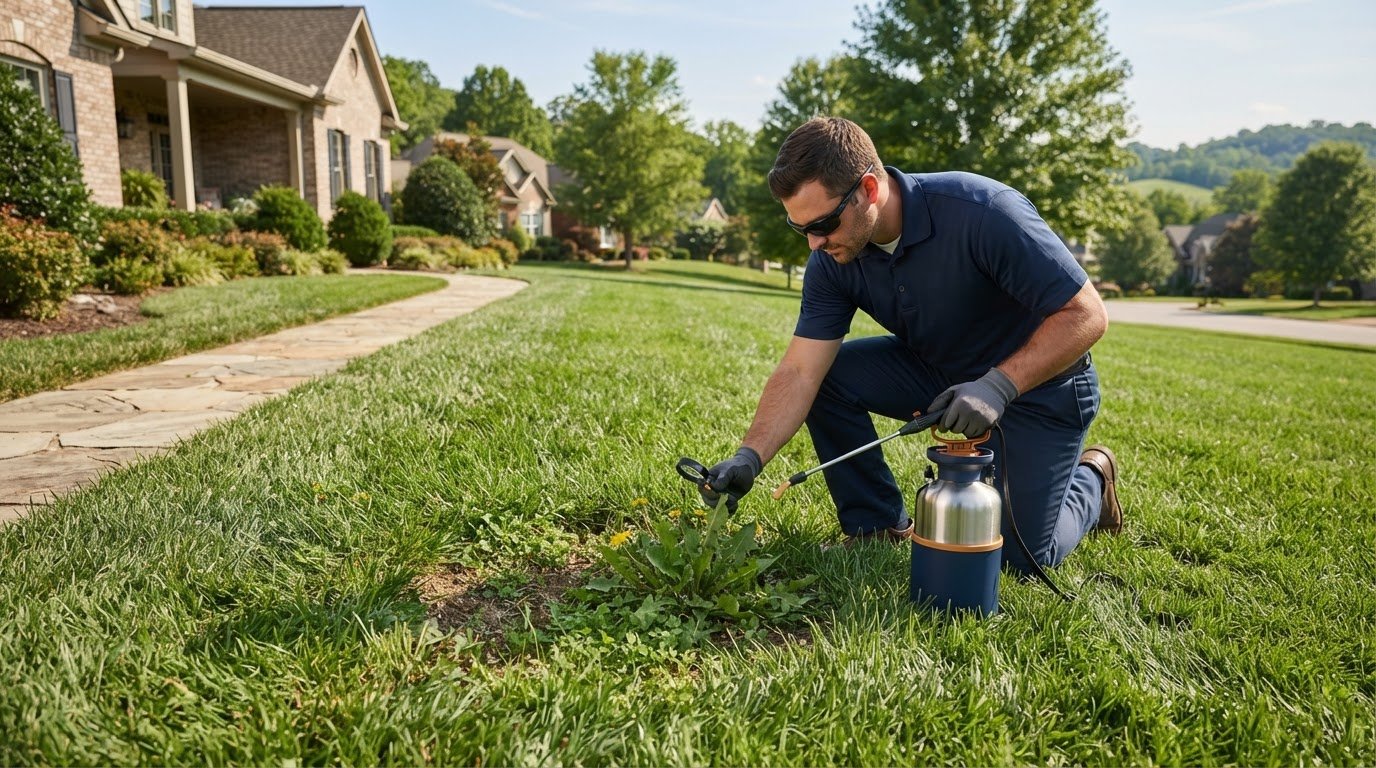
Weeds don’t all respond to the same treatment. Broadleaf weeds such as clover and dandelion may be targets for certain lawn weed control treatments, but results still depend on the product, application timing, and weed growth. Correct identification helps set realistic expectations and avoids treating every unwanted plant as though it were the same problem.
The weed’s identity helps determine the treatment, and the treatment fit helps shape the result. Dallisgrass and Johnsongrass are invasive grassy weeds that can be more difficult to manage than common broadleaf weeds. Standard fertilization and weed control may not address them; a separate or targeted approach may be recommended.
How grass type and turf condition affect expectations
Identify the lawn’s grass before judging whether a treatment is suitable. Mt. Juliet lawns may include cool-season fescue or warm-season grasses such as Bermuda and zoysia. The right approach depends on the turf being protected as well as the weeds being managed. Thin areas, uneven growth, and the extent of weed pressure can also affect the plan.
Bermuda grass that has spread into an established fescue lawn can be extremely difficult to eliminate completely. Management generally focuses on limiting its spread, reducing its presence, and helping the desired fescue remain healthy and competitive. Ongoing management or additional treatment strategies may be needed. If your lawn has mixed grass or persistent weeds, discuss your lawn’s treatment needs with Performance Lawns, INC.
How to compare weed-and-feed lawn applications in Mt. Juliet
A useful comparison looks beyond whether fertilizer and weed control are applied together. Consider whether the approach fits your grass, targets the weeds you actually see, and explains what one application can reasonably accomplish. A single treatment may address a current need, while an ongoing weed-control program can adapt as turf conditions and weed pressure change.
Use this framework to understand what a treatment program covers:
| What to compare | What a lawn-specific approach considers |
|---|---|
| Lawn assessment | Grass type, turf density, visible weeds, and the lawn’s current condition. |
| Weed focus | Whether the treatment is intended for the weeds present, and whether difficult grassy weeds need separate attention. |
| Fertilization | How nutrient support relates to the grass type and the goal of building healthier turf. |
| Timing | Whether application timing reflects active weed and grass growth, along with current weather and lawn conditions. |
| Follow-up | What ongoing monitoring or additional treatment may be appropriate if weeds persist or new ones appear. |
What to compare in a professional treatment program
Look for a clear explanation of the treatment goal, its fit for your lawn, and its limitations. A sound plan doesn’t treat every yard or weed as identical. Performance Lawns, INC provides professional fertilization and weed control for residential and commercial properties in Mt. Juliet and Middle Tennessee, focusing on supporting healthy turf and managing unwanted weeds. Its lawn treatment program considers the lawn’s needs and the weeds present.
When a combined application may not address every weed
Broadleaf weeds and grassy weeds can call for different treatment choices. Dallisgrass and Johnsongrass are invasive grassy weeds that can be harder to manage than common broadleaf weeds. They may require targeted or separate treatment, so don’t assume a standard fertilization and weed-control application will address them. A realistic plan sets expectations around the weed species and the response treatment may support.
Bermuda grass spreading into an established fescue lawn can also be especially challenging. Management generally focuses on reducing its presence, limiting further spread, and helping the desired fescue remain competitive; ongoing efforts may be needed. In Mt. Juliet, compare the treatment goal and follow-up plan, not just the fact that two products or functions are combined. For help with your lawn’s fertilization and weed-control needs, get in touch with Performance Lawns, INC.
What to expect before and after a lawn application
A little observation before treatment can make the lawn’s needs easier to describe and progress easier to assess. In Mt. Juliet, Lebanon, Gallatin, and Hendersonville, think of the process as a sequence: note what’s happening in the yard, establish treatment goals, apply an approach suited to the lawn, then monitor how the turf and weeds respond.
How to prepare useful information about your lawn
You don’t need to diagnose the problem yourself. Simple notes about where weeds appear and whether affected areas seem to be spreading can help create a clearer picture. If you know the grass type, include it, along with any recent changes you’ve noticed in the lawn.
- Mark weed locations: Note whether weeds are scattered, clustered in a particular area, or appearing along an edge.
- Describe changes: Record new bare or thin spots, shifts in turf color, or areas where weed pressure seems to be increasing.
- Share your goal: Say whether you’re focused on reducing visible weeds, supporting thicker turf, or addressing both concerns.
This information gives the treatment plan useful context without assuming every patch has the same cause. A lawn’s appearance can change over time, so observations made before an application also offer a helpful point of comparison later.
How to set realistic expectations after treatment
After an application, monitor the same areas you noted beforehand. Look for changes in the target weeds and surrounding turf, but remember that visible progress depends on weed type, application timing, and the extent of the problem. Weed control is an ongoing management effort, not a promise that every weed will disappear after one treatment.
Some weeds may call for additional attention. Dallisgrass and Johnsongrass, for example, can be more challenging to manage than common broadleaf weeds and may need a targeted or separate treatment approach. Bermuda grass spreading through an established fescue lawn can also be extremely difficult to eliminate completely. Management may focus on limiting its spread and helping the desired turf stay healthy and competitive.
Follow the application’s specific care directions rather than relying on general assumptions about watering, mowing, or how soon to expect a response. If the treatment includes follow-up guidance, use it to track the lawn and understand whether the approach should continue or be adjusted. For help discussing your lawn’s conditions and treatment goals, contact Performance Lawns, INC.
Choose local weed-and-feed care with Performance Lawns
Healthy turf and ongoing weed control take more than applying fertilizer and herbicide at the same time. The treatment should reflect what’s growing in the lawn, the grass you want to support, and the turf’s condition. Performance Lawns provides residential and commercial fertilization and weed control in Mt. Juliet, Lebanon, Gallatin, Hendersonville, and Middle Tennessee, bringing more than 15 years of experience to local lawn care.
A local approach to fertilization and weed control
Each lawn has its own needs. A thoughtful approach considers visible weeds, turf density, grass type, and treatment goals, then sets expectations based on those conditions. Weed-and-feed care can help manage susceptible weeds and support desirable grass, but results vary, and no application can promise a completely weed-free lawn. Difficult grassy weeds may call for separate attention as part of ongoing weed control.
Performance Lawns offers a no-risk guarantee. Learn more about the company’s fertilization and weed-control services through its fertilization and weed control program.
Take the next step for your Mt. Juliet lawn
A useful starting point is a clear picture of your lawn: the grass type, weeds you’ve noticed, and any changes in the turf. Sharing what you hope to improve, such as reducing weed pressure or supporting thicker grass, helps focus the conversation on an appropriate treatment goal. Local weed-and-feed care works best as part of a considered approach, not as a blanket promise tied to one application.
Whether you’re caring for a residential yard or commercial property in Mt. Juliet, Lebanon, Gallatin, or Hendersonville, Performance Lawns can help you consider fertilization and weed control suited to your lawn’s conditions. Talk with Performance Lawns about your lawn.
Build a healthier lawn with a thoughtful plan
Strong weed control starts with understanding the lawn in front of you. Grass type, weed species, turf condition, and application timing all shape which treatment may be appropriate and what results to expect. In Mt. Juliet, Lebanon, Gallatin, and Hendersonville, a combined application can pair turf nutrition with weed control, but it’s one part of ongoing care, not a promise that weeds will disappear completely.
Performance Lawns provides residential and commercial fertilization and weed control, backed by more than 15 years of experience and a no-risk guarantee. A lawn-specific approach can help support healthy turf and manage unwanted weeds while recognizing that some conditions call for targeted or continued attention.
Take the next step with a clear picture of your grass, the weeds you’ve noticed, and what you’d like to improve. Talk with Performance Lawns about your Mt. Juliet lawn. With informed treatment and ongoing care, you can work toward healthier, more attractive turf.
Frequently Asked Questions
What are weed-and-feed lawn applications?
Weed-and-feed lawn applications combine turf fertilization with weed-control treatment. The fertilizer supports grass growth, while the weed treatment targets susceptible weeds, with the goal of helping desirable turf grow while managing unwanted plants. These applications don’t guarantee a weed-free lawn. Suitability and results depend on the grass type, lawn condition, weeds present, timing, and whether the treatment matches the property’s needs.
When should weed-and-feed be applied in Mt. Juliet?
There isn’t one application date that fits every Mt. Juliet lawn. Timing depends on the weeds present, grass type, weather, and current turf condition. A treatment intended for existing weeds may have different timing considerations than one intended to limit weed germination. Local conditions can shift the appropriate window, so a lawn assessment can help determine an approach suited to your yard.
Does weed and feed kill every type of lawn weed?
No. Weed-and-feed applications shouldn’t be expected to eliminate every weed, since different species respond to different treatment approaches. Some products target certain broadleaf weeds, while invasive grassy weeds such as Dallisgrass and Johnsongrass can be more challenging and may need separate or targeted treatment. Results depend on the weed, timing, and lawn conditions. Think of weed control as ongoing management, not a guarantee of total elimination.
Can one weed-and-feed application control Dallisgrass or Johnsongrass?
One standard application shouldn’t be assumed to control Dallisgrass or Johnsongrass. These invasive grassy weeds can be more difficult to manage than many common broadleaf weeds and may not respond to the treatments typically used for broadleaf weeds. A separate or targeted approach may be recommended. Treatment expectations depend on the lawn and weed conditions, and ongoing management may be needed rather than relying on a single combined application.
Is weed and feed enough to manage Bermuda grass in a fescue lawn?
Not necessarily. Bermuda grass that spreads into an established fescue lawn can be extremely difficult to eliminate completely. Management generally focuses on limiting its spread, reducing its presence, and helping the desired fescue remain healthy and competitive. A standard weed-and-feed application shouldn’t be treated as a guaranteed fix for this issue. Ongoing management or additional treatment strategies may be appropriate, depending on the lawn’s condition and goals.
How do I choose a weed-and-feed lawn service in Mt. Juliet?
Look for a lawn-specific approach that considers grass type, visible weeds, turf condition, fertilization needs, and follow-up care. Performance Lawns provides residential and commercial fertilization and weed control in Mt. Juliet, Lebanon, Gallatin, and Hendersonville. With over 15 years of experience, the company focuses on supporting healthy turf and managing unwanted weeds. Treatment expectations should be realistic, especially for difficult grassy weeds that may need targeted attention.
Will weed-and-feed improve the health of my lawn?
It can support lawn health when the treatment fits the turf’s needs. Fertilization supplies nutrients that support grass growth, while weed control helps manage susceptible unwanted plants. Results depend on the lawn’s condition, weed pressure, timing, and treatment choice. A combined application doesn’t address every lawn-care need or guarantee a particular outcome. In Mt. Juliet and nearby Middle Tennessee communities, weed-and-feed is best considered within an ongoing plan for healthier turf and weed management.