

Crabgrass Control in Middle Tennessee: 5 Common Myths Ruining Your Lawn
By the time you actually see crabgrass clumping through your Fescue, you've already lost the first battle of the summer. It's an exhausting cycle that many homeowners in our community know all too well. You invest your time, your energy, and your weekend budget into DIY products, yet the weeds still arrive like clockwork. If you're tired of the embarrassment of a patchy yard, you aren't alone. The unique climate of the Transition Zone demands more than just a generic bag of chemicals from a big-box store. Achieving effective crabgrass control Middle Tennessee requires a blend of local expertise, professional-grade products, and precise timing that accounts for our specific soil temperatures.
We believe your outdoor space should be a source of peace, pride, and personal freedom. In this guide, we'll show you how to stop the endless cycle of summer weeds by exposing the myths that are ruining your turf. You'll learn the science behind our 2026 maintenance strategies and how a disciplined approach to timing can transform your lawn. We're pulling back the curtain on why professional pre-emergents outperform retail versions, how to navigate our fickle weather patterns, and what a truly healthy Fescue schedule looks like. It's time to trade confusion for clarity and reclaim the thick, green lawn you've always wanted.
The Crabgrass Identity Crisis: Why It Is Not Just Another Weed
Identifying the enemy is the first step toward a pristine lawn. In Mt. Juliet and Lebanon, homeowners often mistake clumpy patches for "coarse Fescue" or Quackgrass, but the reality is usually more aggressive. Common crabgrass (Digitaria) is a summer annual that doesn't just grow; it colonizes. It thrives on heat, survives on neglect, and dominates through sheer volume. For the 2026 season, understanding this distinction is vital for effective fertilization and weed control.
This weed is a relentless opportunist. While your Tall Fescue struggles during the sweltering Tennessee July, crabgrass finds every thin spot, every bare patch, and every sidewalk edge to take root. It doesn't need much to succeed. It simply waits for your turf to stress, then fills the void with clumpy, lime-green eyesores that ruin your home's curb appeal. If your lawn isn't a thick, competitive carpet, you're essentially rolling out a welcome mat for these invaders.
The Lifecycle of a Middle Tennessee Invader
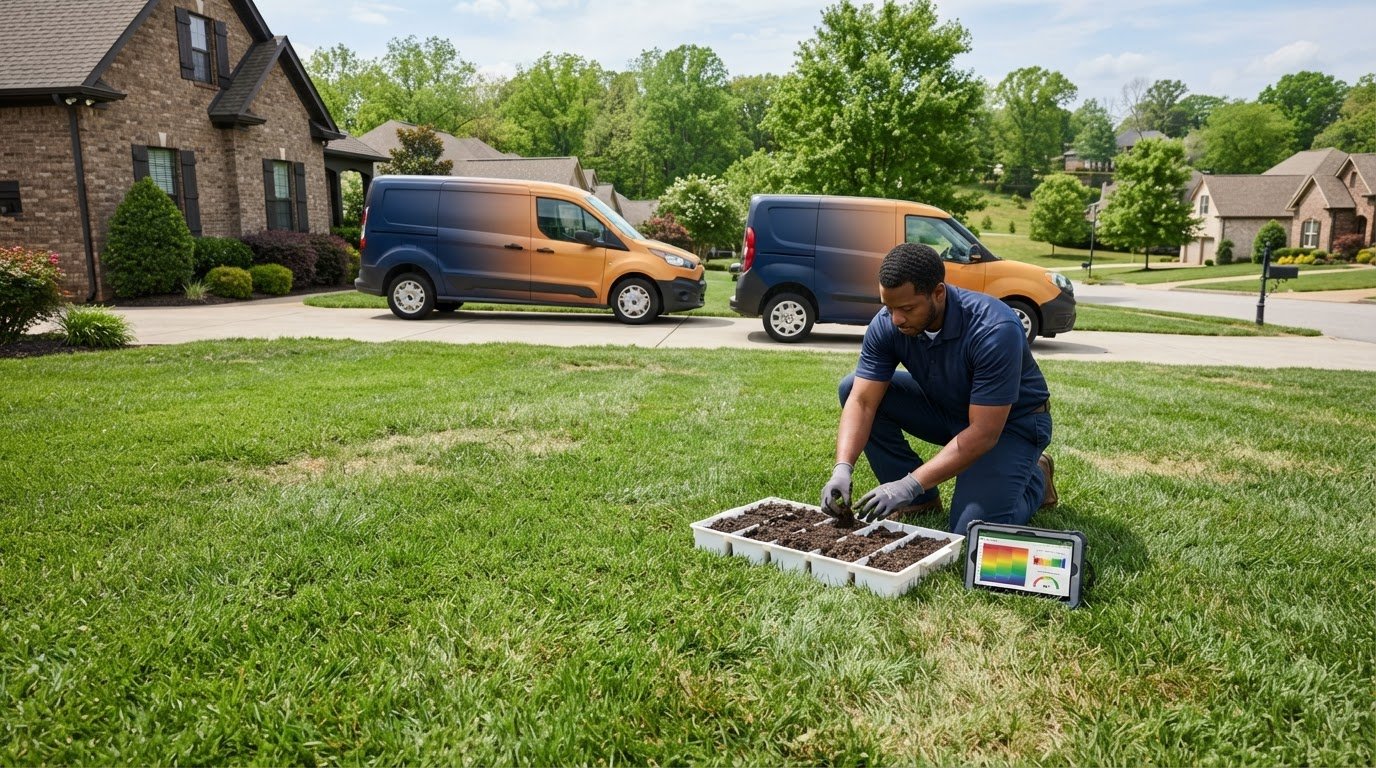
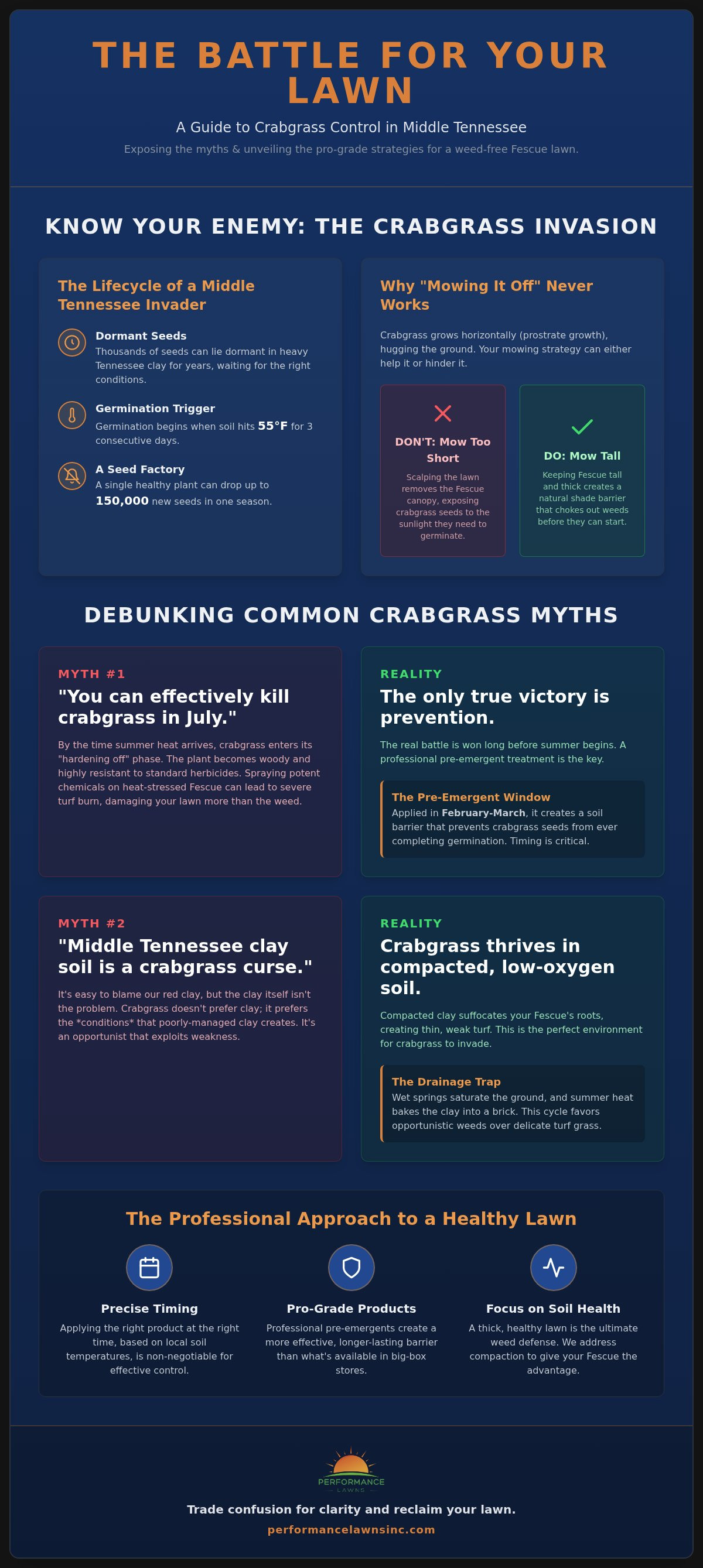
The real battle for crabgrass control Middle Tennessee begins long before you see a single leaf in your yard. Germination is triggered by a specific biological starting gun: when soil temperatures at a two-inch depth hit 55 degrees for three consecutive days. In our region, this window usually opens in early spring. Once it wakes up, the plant becomes a seed factory. A single healthy plant can drop up to 150,000 seeds in one season. These seeds are incredibly resilient; they can sit dormant in our heavy Tennessee clay for years, waiting for the perfect moment of sunlight and moisture to emerge.
Why "Mowing it Off" Never Works
Many well-meaning homeowners try to scalp the problem away. This strategy backfires every time. Crabgrass has a prostrate growth habit, meaning it spreads horizontally across the ground rather than just growing upright. When you mow too short, you aren't hurting the weed; you're actually removing the canopy that shades the soil. This exposes dormant seeds to direct sunlight, providing the exact warmth they need to germinate. Crabgrass is a heat-loving annual that produces thousands of seeds per plant to ensure future dominance. Proper maintenance requires keeping your Fescue tall to choke out these invaders naturally. By cutting too low, you're literally feeding the enemy the sunlight it needs to thrive.
Myth #1: You Can Effectively Kill Crabgrass in July
By the time July heat settles over Middle Tennessee, many homeowners are in full-blown battle mode. It's a frustratingly common sight in Mt. Juliet: clumpy, light-green stalks disrupting the uniform look of your turf. However, the idea that you can simply spray these away in mid-summer is a costly misunderstanding. By this point, crabgrass has entered its "hardening off" phase. The plants become woody and remarkably resistant to standard herbicides. The Purdue University crabgrass control guide notes that post-emergent treatments lose their efficacy significantly once the plant matures past mid-July.
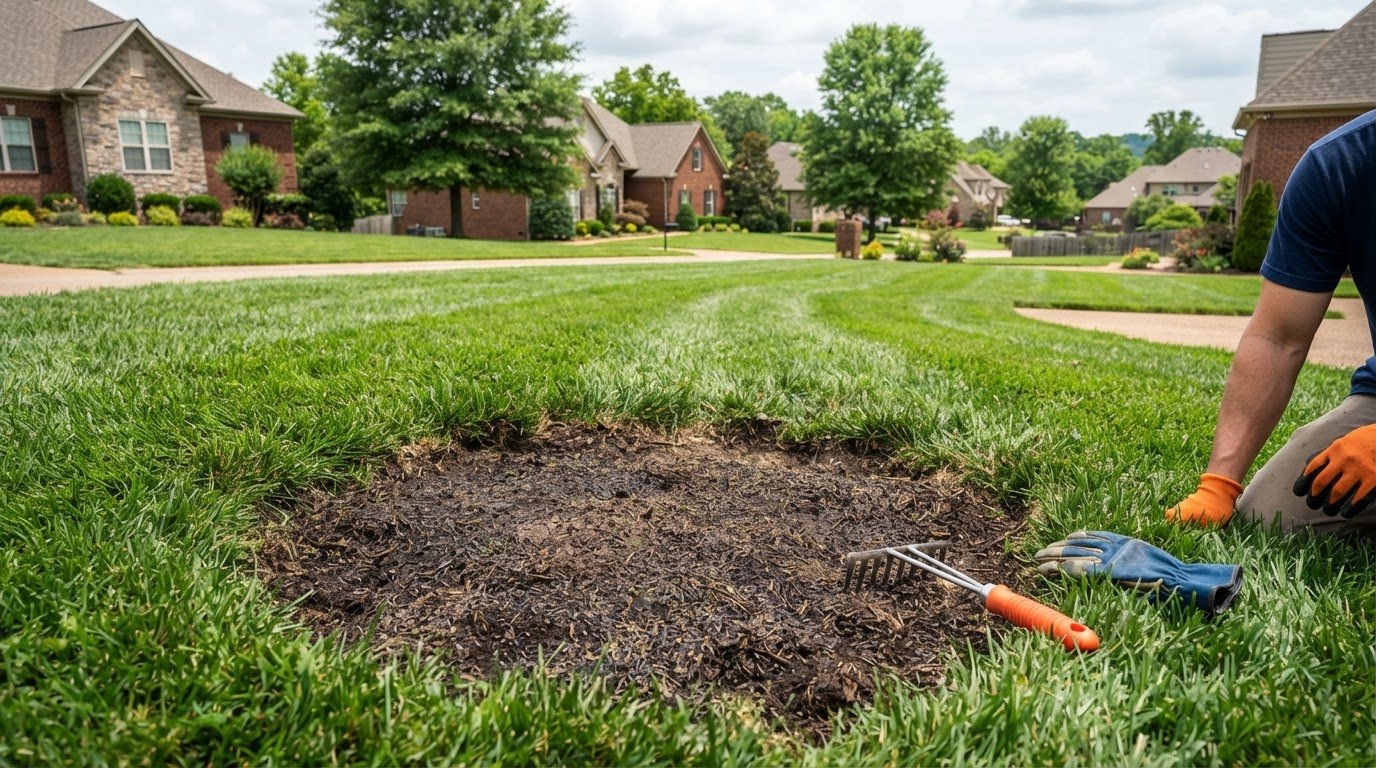
Attempting a heavy chemical intervention during the peak of the 2026 summer carries real risks for your property. Your Fescue is probably already struggling with heat stress; adding potent herbicides can lead to severe turf burn. You might end up with yellow, dead patches while the crabgrass stays green. Even if the herbicide manages to kill the plant, the damage is already done. The mature weed has likely already deposited its next generation of seeds into your soil. True crabgrass control Middle Tennessee relies on prevention, not reaction.
The Pre-Emergent Window: The Only Battle That Truly Matters
The real victory is won long before the summer sun arrives. During February and March, we focus on establishing a "vapor barrier" in the soil. This treatment doesn't kill active plants; instead, it prevents seeds from ever completing the germination process. In our local climate, the timing is razor-thin. If you miss this window by even a few days, the soil temperature may rise enough to let thousands of seeds sprout. Once they break through, that barrier is no longer effective.
Post-Emergent: The "Emergency Only" Tool
We treat post-emergents as a secondary line of defense. These are only effective when the weed is in the "early tiller" stage, looking like small, young fingers. For these situations, professional liquid weed control is essential. Granular "weed and feed" products rarely provide the leaf-surface contact needed to stop a growing weed. If you're seeing an invasion right now, it's best to consult with a local expert to see if a late-season treatment is safe for your lawn.
Myth #2: Middle Tennessee Clay Soil is a Crabgrass Curse
Many homeowners in Lebanon and Gallatin look at their red clay and see an inevitable weed patch. It's easy to believe that our local soil is simply cursed. However, the clay isn't the problem; the condition of the soil is. Crabgrass thrives in the low-oxygen environment of compacted clay. While your Fescue struggles to breathe, these weeds are perfectly comfortable in the tight, airless spaces. This creates what we call the "Drainage Trap." Our wet Tennessee springs saturate the ground, followed by 2026 summer heat that bakes the clay into a brick. This cycle of drowning and hardening favors opportunistic weeds over delicate turf grass.
The University of Maryland Extension on crabgrass notes that this weed is specifically adapted to thin turf and high-compaction areas. By focusing on soil health as your ultimate weed barrier, you can flip the script on your lawn's environment. We see this as a form of stewardship. You are not just killing weeds; you are cultivating an ecosystem where they cannot survive. Lasting results require investment, precision, and local knowledge.
Compaction: The Silent Invitation
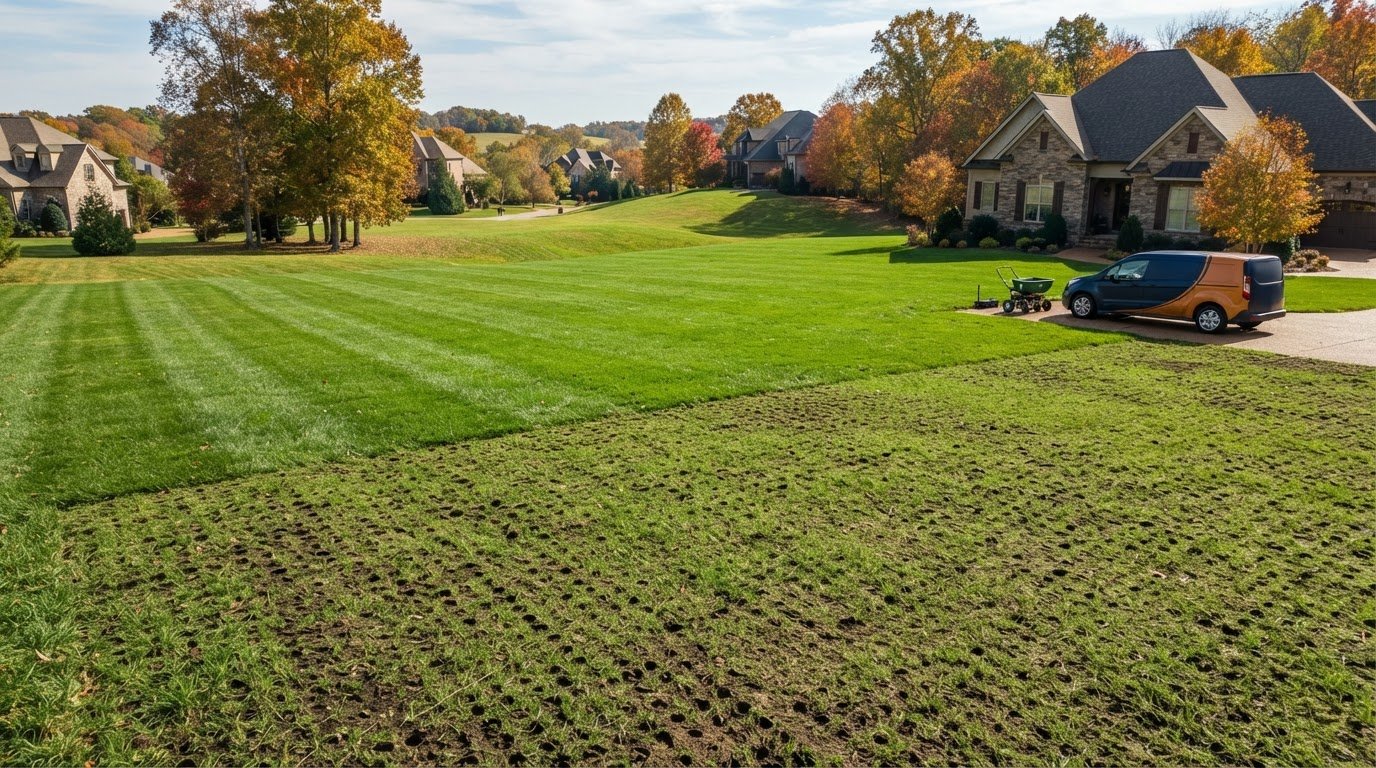
Compaction happens slowly. Every footstep, every heavy rainstorm, and every season of gravity packs the soil tighter. As the clay compresses, Fescue roots find it impossible to penetrate deep enough to find moisture during a drought. Crabgrass doesn't face the same limitations. It stays shallow and aggressive, taking over the space your grass has abandoned. Breaking this cycle is essential for lasting crabgrass control Middle Tennessee . We recommend core aeration services to physically remove small plugs of soil, allowing oxygen, water, and nutrients to finally reach the root zone.
The pH Factor in Weed Success
Middle Tennessee clay is naturally acidic. When the pH level drops too low, it creates a chemical "lockout" where your grass cannot absorb the fertilizer you've applied. Ironically, many common weeds are much more tolerant of these acidic conditions. A professional lawn health assessment is the only way to know exactly what your soil needs. Without balancing the chemistry, you're essentially feeding the weeds while your grass starves. Aeration is the most effective way to break the compaction cycle in Middle Tennessee clay.
Myth #3: Thick Grass is Only for Aesthetics
A lush, velvet-green lawn is certainly a point of pride for any homeowner, but its value goes far deeper than visual appeal. In the natural world, nature abhors a vacuum. If there's an empty space in your soil, something will eventually fill it. When your Fescue is thin or patchy, you're essentially providing a nursery for opportunistic weeds. A dense turf canopy is your lawn's first and most effective line of defense. By cultivating a thick stand of grass, you create a biological barrier that makes crabgrass control Middle Tennessee significantly more manageable.
This "Shade Strategy" is a simple yet powerful biological tool. Crabgrass seeds require direct sunlight and warm soil to wake up from dormancy. When you maintain a lawn height of 3.5 to 4 inches, the long blades of Fescue cast deep shadows across the soil surface. This keeps the ground cooler and darker, preventing thousands of dormant seeds from ever receiving the signal to germinate. It's a method that prioritizes health, density, and resilience over chemical volume. If you want to see how this fits into a comprehensive plan, read our guide on Professional Weed Control in Middle Tennessee.
The Fall Aeration and Overseeding Connection
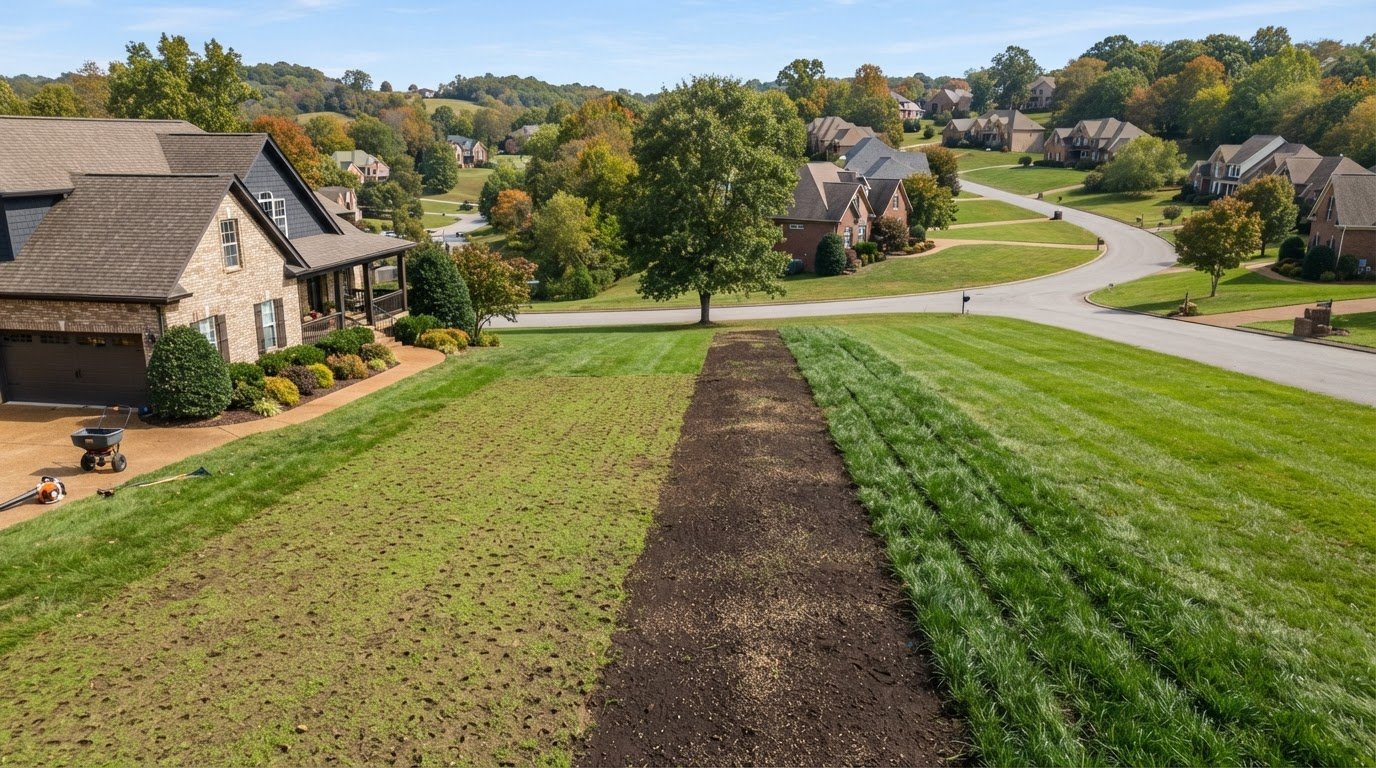
While most people think about weeds in the summer, the real success of your 2026 program begins in September. Fall is the ideal window to build a weed-proof lawn. Performance Lawns, INC focuses on residential aeration and overseeding during this time to ensure your turf is as thick as possible before the next spring arrives. By using high-quality Fescue seed and ensuring proper seed-to-soil contact through core aeration, we help you crowd out space that crabgrass would otherwise claim. A thick lawn established in the fall is the best insurance policy against a weed-filled summer.
Mowing for Weed Suppression
Your mowing habits directly impact how well your lawn can fight off invaders. For Middle Tennessee lawns, we recommend keeping your mower deck set to at least 3.5 inches. This height supports deeper root growth and maintains that critical soil-shading canopy. You should also follow the "One-Third Rule," never removing more than a third of the grass blade in a single cutting. This prevents the physiological stress that thins out Fescue and invites weeds in. Always ensure your mower blades are sharp; a clean cut heals quickly, while a shredded leaf blade creates an entry point for disease and weakens the plant's competitive edge. If you're ready to build a more resilient lawn, reach out to our team today.
Myth #4: DIY Products are Just as Good as Professional Grade
Walking down the lawn care aisle of a big-box store in Mt. Juliet can be overwhelming. Dozens of bags claim to be the ultimate solution, but there's a reason DIY efforts often fall short of professional crabgrass control Middle Tennessee . Most consumer-grade products rely on granular applications. These pellets must land perfectly on a wet leaf to have any effect; even then, they lack the specialized surfactant technology that professional teams utilize. Performance Lawns, INC uses high-grade additives that break down the surface tension on the weed's waxy leaves, ensuring the product sticks and absorbs where it's needed most. Without this technology, you're often just washing expensive chemicals into the storm drain during the next heavy Tennessee rain.
There's also the significant risk of over-application. Homeowners, frustrated by stubborn weeds, often apply too much product in hopes of a faster result. This frequently leads to turf burn, where the herbicide kills the desired Fescue along with the weeds. Our team uses precision-calibrated equipment to ensure exactly the right amount of product is applied to every square foot. This disciplined approach is why we can offer a no-risk guarantee on our lawn treatments. If you aren't satisfied, Performance Lawns, INC will make it right, providing a level of peace of mind that a store-bought bag simply cannot match.
The Cost of "Doing it Twice"
The initial price of a DIY bag is deceptive. When you factor in the cost of spreaders, safety equipment, and the multiple trips to the store when the first application fails, the savings vanish. You also have to consider the value of your time. Professional timing saves money over a 12-month period because we stop the problem before it requires expensive, high-dose corrective treatments. Instead of a one-size-fits-all bag, we provide a customized lawn care plan tailored to the specific needs of your soil and turf. It's about investing in long-term quality rather than just buying a temporary fix that might actually damage your property.
Expertise You Can Trust
With over 15 years of local experience in Mt. Juliet and Lebanon, we've seen every weather pattern the Transition Zone can throw at us. Performance Lawns, INC doesn't just follow a calendar; we adjust our treatments based on real-time 2026 weather data and soil temperatures. This regional expertise allows us to act as a partner in your lawn's success, removing the burden of maintenance while delivering high-end results. Don't waste another weekend on products that don't work. Contact Performance Lawns, INC for a free estimate and finally get the thick, weed-free lawn you deserve.
Take the First Step Toward a Weed-Free 2026
Stop fighting a losing battle against nature and start working with it. Achieving lasting crabgrass control Middle Tennessee isn't about how many chemicals you can spray in July. It's about respecting the unique challenges of our local clay, understanding the 2026 growing season, and investing in the long-term health of your soil. By prioritizing fall aeration, proper mowing heights, and the precision of professional-grade treatments, you move beyond mere maintenance and toward a holistic investment in your property’s value and your personal pride.
We're proud to be your dedicated local partner, bringing 15+ years of Middle Tennessee expertise to every lawn we treat. As a locally owned and operated business, we take personal responsibility for the aesthetic and functional health of our community. Our no-risk guarantee ensures that your journey toward a thick, green Fescue lawn is supported by reliability, integrity, and precision. You don't have to carry the burden of complex timing alone. Reclaim your yard from crabgrass—get your free quote today! We look forward to helping you cultivate a landscape that brings you peace of mind all summer long.
Frequently Asked Questions
When should I put down crabgrass preventer in Middle Tennessee?
You should apply crabgrass preventer in Middle Tennessee between late February and mid-March. The biological trigger for germination is when soil temperatures at a two-inch depth reach 55 degrees for three consecutive days. For the 2026 season, we monitor local soil probes to ensure the vapor barrier is established before the first seeds wake up. Waiting until you see the weeds means you've missed the most effective window for prevention.
Can I overseed my lawn and put down crabgrass preventer at the same time?
No, you cannot successfully overseed while using standard pre-emergent preventers. These products create a barrier that stops all seeds from germinating, including your expensive Fescue. If you apply them together, your new grass will never sprout. This is why we separate these services. We focus on heavy residential aeration and overseeding in the fall and save the preventer for the spring window to ensure your lawn stays thick and healthy.
Why do I have crabgrass even though I used a pre-emergent?
Several factors can cause breakthrough even after an application. The most common reasons include missing the narrow timing window, soil disturbance from digging, or using lower-quality retail products. Professional-grade treatments often provide 6 to 9 months of protection, whereas big-box versions may degrade faster. Effective crabgrass control Middle Tennessee also depends on turf density; if your grass is thin, the barrier has to work much harder to stop invaders.
Is it too late to kill crabgrass in August?
August is generally too late for effective chemical control because the plants have "hardened off" and become resistant to herbicides. At this stage of the 2026 season, mature plants are focused on dropping seeds for next year. Attempting to kill them now often results in turf burn for your heat-stressed Fescue. Instead of risking your grass, we recommend focusing on a strong fall aeration and overseeding program to crowd out the next generation.
Does aeration help with crabgrass control?
Yes, aeration is a critical component of a long-term weed suppression strategy. Crabgrass thrives in the compacted, low-oxygen clay found throughout Mt. Juliet and Lebanon. By pulling core plugs, we allow oxygen, water, and nutrients to reach the root zone of your Fescue. This encourages deeper roots and a thicker canopy, which naturally shades the soil and prevents dormant seeds from receiving the sunlight they need to germinate in the spring.
What is the best mowing height to prevent crabgrass in Tennessee?
The ideal mowing height for Middle Tennessee lawns is between 3.5 and 4 inches. Keeping your Fescue tall provides a natural defense by shading the soil surface. This cooler, darker environment prevents crabgrass seeds from germinating. Shorter grass allows more sunlight to reach the ground, which warms the soil and signals weeds to grow. Maintaining a higher deck height also reduces plant stress during our sweltering summer months.
Is crabgrass control safe for my pets?
Our professional lawn treatments are designed with your family's safety in mind. We recommend keeping pets and children off the lawn until the liquid application has completely dried, which typically takes one to two hours depending on the weather. Once the product is dry, it is perfectly safe to resume normal outdoor activities. As a locally owned and operated business, we prioritize the health and safety of our neighbors and their beloved pets.
How many years does it take to fully get rid of crabgrass?
Eliminating crabgrass is a multi-year commitment because seeds can remain dormant in our clay soil for several seasons. While you will see a significant improvement after one year of professional crabgrass control Middle Tennessee , it often takes two to three years of consistent timing and soil health improvements to fully break the cycle. Each season of prevention reduces the seed bank in your soil, making your lawn increasingly resilient against future invasions.